
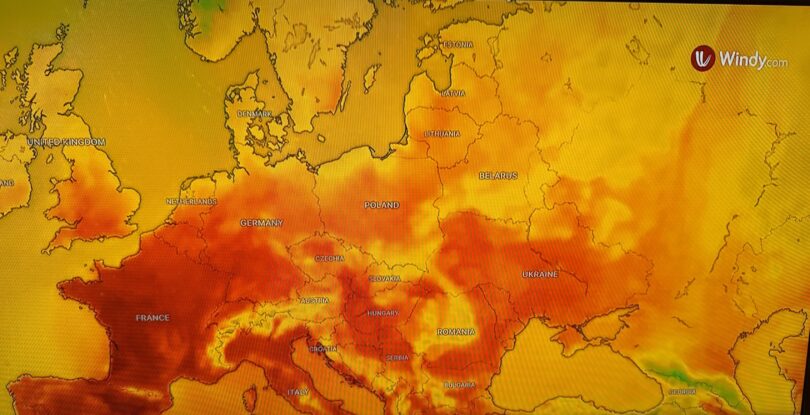

EUROPE ‘COOKING’ AS HISTORIC JUNE HEATWAVE SMASHES RECORDS ACROSS UK, FRANCE, AND SPAIN
Climate and Weather Report /News aggregator using Gemini AIO
Posted Thursday 23 June,2026/Refreshed Friday 26 June
PARIS — A ferocious early-summer heatwave has gripped Western Europe, shattering decades-old meteorological records, straining power grids, and prompting emergency public health closures across France, the United Kingdom, and Spain.
Driven by a slow-moving atmospheric system known as an “Omega block,” a massive dome of high pressure has trapped an influx of blistering air from the Sahara Desert directly over the continent. The result is unprecedented June heat that climate scientists warn is arriving earlier and with far greater intensity than historical baselines.
France Endures Its Hottest Night on Record
In France, the national weather agency Météo-France announced that the country experienced its highest-ever average nighttime temperatures on Monday into Tuesday. Daytime highs peaked at a staggering 44.3°C (111.7°F) in Pissos, establishing the hottest day on record since measurements began nearly 80 years ago. In Paris, temperatures hit a local June record of 40.9°C (105.6°F).
The human toll has already turned tragic. French authorities confirmed at least 48 drowning deaths since the onset of the heatwave, as thousands of residents sought desperate respite in unsupervised rivers, lakes, and canals.
“There is a tragic scourge of drownings,” Prime Minister Sébastien Lecornu stated during a crisis meeting with ministers.
Météo-France placed 72 departments—home to more than three-quarters of mainland France’s population—under a top-tier “red alert”. The severe conditions have forced the rescheduling of end-of-school exams, shortened visiting hours at the Louvre, and prompted Paris to launch an emergency level-4 heatwave plan to keep public parks open all night. Furthermore, the country’s nuclear power plants were forced to cut output by roughly seven percent of total demand as high water temperatures limited access to critical cooling water.
United Kingdom Braces for All-Time June Peak
Across the English Channel, the UK Met Office issued a rare red extreme heat warning as the country logged its highest-ever June temperature. A blistering provisional high of 36.4°C (97.5°F) was recorded in Yeovilton, Somerset, breaking a record set just a day prior in Hampshire. This entirely obliterated the UK’s previous June peak of 35.6°C (96.1°F), which had stood since 1976. Even Cardiff, Wales broke records with a sweltering overnight low that failed to drop below 23.5°C (74.3°F).
Speaking at a special address during London Climate Action Week, United Nations Secretary-General António Guterres issued a blistering indictment of global fossil fuel dependence as the primary driver behind the crisis:
“From rising energy bills to children breathing polluted air and communities being hit by floods, droughts and extreme heat, the costs of our dependence on fossil fuels are now impossible to ignore. London isn’t just calling. It’s cooking. The worsening climate crisis and growing energy insecurity share a common root: the world’s continued dependence on fossil fuels.”
In response to the heat, the ceremonial guard changes outside Buckingham Palace were canceled for the rest of the week, and organizers of London Climate Action Week were forced to cancel several of their own outdoor events on extreme heat. London Mayor Sadiq Khan launched the city’s first formal heat plan, acknowledging that “extreme temperatures are no longer a future threat, they are a present danger,” as local pavements and transit platforms recorded surface temperatures between 50°C and 60°C.
Continental Impact: Spain and Switzerland Swelter
The intense weather systems are squeezing neighboring nations as well:
-
Spain: The national weather agency AEMET confirmed the country recorded its highest daily average temperatures for June since at least 1950, with the northern village of Tama hitting a record high of 43.7°C (110.7°F). Dry conditions have supercharged wildfire risks across the region.
-
Switzerland: National meteorologists reported that Swiss temperatures exceeded 37°C for the first time in June, eventually peaking at 38.0°C (100.4°F) at the Basel weather station to break a historical record stretching back to 1947.
-
The Netherlands: Authorities issued an extreme heat warning, scaling down public transport networks, shortening school classes, and canceling outdoor sporting events as temperatures surged toward 36°C.
Rapid scientific analysis indicates that carbon pollution from burning fossil fuels has amplified this heatwave, making temperatures between 2°C and 4°C hotter than they would have been under normal conditions. Forecasters warn that the rigid “heat dome” structure means there will be little to no atmospheric relief until late into the week, raising fears that this historic June anomaly is merely a precursor to an intensely punishing summer ahead.
*Previous Report here
PARIS — A ferocious early-summer heatwave has gripped Western Europe, shattering decades-old meteorological records, straining power grids, and prompting emergency public health closures across France, the United Kingdom, and Spain.
The arrival of a relentless, slow-moving atmospheric “heat dome” has pushed western Europe into unchartered meteorological territory. A massive ridge of high pressure—acting like a thermal lid—has trapped a plume of scorching air stretching from the Sahara Desert directly across Spain, France, and the United Kingdom.
The resulting early-summer heatwave is breaking century-old local records, forcing emergency grid interventions, and fundamentally altering daily life across the continent. Rather than an isolated weather event, climate scientists note that the intensity and timing of this system match a broader, accelerating trend: summer heat extremes in western Europe are now warming nearly three times faster than the global average.
1.Iberian Peninsula Swelters as Spain Tops 44°C
Spain has declared its first official heatwave of the year, with the state meteorological agency AEMET forecasting daytime highs to reach up to 44°C (111.2°F) in the southern river valleys. Even traditionally cooler northern cities like San Sebastián are seeing temperatures double their historical June averages, pushing past 40°C.
The extreme conditions have forced municipalities to alter daily life:
- Public Events Canceled: In Madrid, planned large-scale public outdoor events, including a massive World Cup viewing party, were abruptly canceled due to safety risks.
Insurance Journal - Nighttime Heat: Large swaths of central and southern Spain are failing to drop below 30°C (86°F) at night, triggering widespread sleep disruption and straining local electrical grids as air conditioning usage hits historic peaks.
- Wildfire Risks: Parched soils and desiccated vegetation have triggered extreme wildfire warnings across the Iberian peninsula, with emergency services deployed on high alert.
Insurance Journal
The Iberian Peninsula is bearing the initial brunt of the atmospheric block. Severe weather alerts cover nearly the entire country as daytime highs climb to 44°C (111.2°F) along the Guadalquivir and Guadiana river valleys.
What makes this system particularly dangerous is the total absence of nighttime cooling. Major urban hubs are enduring successive “torrid nights”—where temperatures remain stubbornly above 25°C to 30°C (77°F to 86°F) long after midnight.
- Grid Infrastructure Strained: Local electrical grids are seeing historic spikes in demand as millions of air conditioning units run continuously through the night.
- Flash Drought & Fire Risks: Coming on the heels of fluctuating seasonal rainfall, the sudden spike in temperature has triggered a “flash drought,” rapidly dehydrating topsoil and vegetation. Forestry services have escalated wildfire readiness to maximum levels, citing an unprecedented risk of high-intensity, fast-spreading blazes.
2. France Declares Red Alerts and School Closures
In France, the national weather office confirmed that the country just experienced its warmest average nighttime minimums since records began. Daytime temperatures peaked at an astonishing 43.3°C (109.9°F) in central regions, prompting authorities to place roughly half of the country’s mainland departments on top-tier red alerts.
The public health response has been swift and sweeping:
- Infrastructure Halts: More than 800 schools have suspended in-person classes or moved to remote setups to protect vulnerable children.
- Transport Vulnerabilities: Regional rail networks have ordered trains to reduce speeds across hundreds of miles of track, a precautionary measure against steel rails buckling under extreme thermal expansion.
- Water Safety Emergency: Public safety officials have reported a tragic spike in accidental drownings, as thousands of people seek relief in unsupervised rivers, lakes, and industrial canals, prompting emergency deployments of extra lifeguards and river patrols.
3. The United Kingdom Braces for Substantial Overheating
Across the English Channel, the typically temperate United Kingdom is preparing for unprecedented conditions. Meteorologists have issued rare extreme heat warnings as models project daytime peaks exceeding 39°C (102.2°F) across southern and central England.
A peak of this magnitude would thoroughly shatter the UK’s historical June record of 35.6°C (96.1°F). Because British architecture and infrastructure are historically designed to retain heat rather than dissipate it, the domestic impact is severe.
Hospitals have triggered surge capacity protocols to handle an influx of heat-related illnesses, while transit operators have issued “do not travel” advisories across London’s older underground subway lines, which lack modern climate control systems.
4. The Broader Climate Context
This early-summer crisis underscores a profound shift in European climate dynamics. Recent atmospheric modeling indicates that western Europe has become a global hotspot for heatwave acceleration.
The combination of general global warming, localized drying of European soils, and an increasing frequency of persistent, high-pressure atmospheric blocking patterns means that events once considered statistical anomalies are becoming the baseline. With the core of summer still weeks away, this historic June system leaves much of the continent bracing for a deeply challenging season ahead.
Driven by a slow-moving atmospheric system known as an “Omega block,” a massive dome of high pressure has trapped an influx of blistering air from the Sahara Desert directly over the continent. The result is unprecedented June heat that climate scientists warn is arriving earlier and with far greater intensity than historical baselines.
France Endures Its Hottest Night on Record
In France, the national weather agency Météo-France announced that the country experienced its highest-ever average nighttime temperatures on Monday into Tuesday. Daytime highs peaked at a staggering 43.3°C (109.9°F) in Châteaumeillant, while the southwest region of Landes saw temperatures climb to 42.2°C (108°F).
Residents seek relief from relentless heat at a public fountain in Paris.. Source: Sight Magazine
The human toll has already turned tragic. French authorities confirmed at least 40 drowning deaths since June 18, as thousands of residents sought desperate respite in unsupervised rivers, lakes, and canals.
“There is a tragic scourge of drownings,” Prime Minister Sébastien Lecornu stated during a crisis meeting with ministers.
Roughly half of France’s mainland departments—49 out of 96—remain on top-tier “red alert,” forcing the closure of over 800 schools and severe disruptions to regional rail networks due to the risk of tracks buckling under the heat.
United Kingdom Braces for All-Time June Peak
Across the English Channel, the UK Met Office issued its second-ever red extreme heat warning as the country braces for temperatures expected to surpass 39°C (102°F) by Wednesday. This would completely obliterate the UK’s previous June record of 35.6°C (96.1°F), which has stood since 1976
Speaking at a London Climate Action Week event, United Nations Secretary-General António Guterres issued a stark warning on the global trajectory of fossil-fuel-driven warming
“London isn’t just calling. It’s cooking. A climate crisis is pushing us deeper towards higher temperatures and closer to catastrophic tipping points.”
In response to the heat, schools across England closed their doors early on Tuesday, and transport authorities issued widespread “do not travel” warnings as consecutive “tropical nights”—where evening temperatures fail to drop below 20°C—offer Londoners no nocturnal relief.
Forecasters warn that the persistent “heat dome” structure means there will be little to no breeze or atmospheric relief across Western Europe until late into the week, raising fears that this historic June anomaly is merely a precursor to an intensely punishing summer ahead.