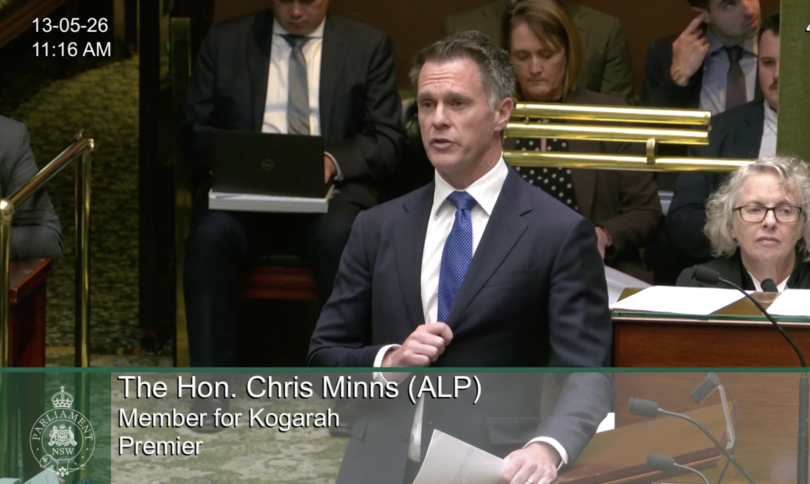


CHRIS MINNS – QUESTION TIME – RESPONSE TO THE FEDERAL BUDGET
PARLIAMENTARY QUESTION TIME – WEDNESDAY, 13 MAY 2026
DAVID MEHAN MEMBER FOR THE ENTRANCE:
Thanks Speaker, I’ve got a question for the Premier. Can the Premier please outline the challenges laid out in the federal budget when it comes to critical infrastructure in New South Wales?
CHRIS MINNS PREMIER OF NEW SOUTH WALES:
Thank you Speaker, I thank the Member for his question this is an important one for New South Wales.
There are aspects of last night’s budget, particularly in the housing part of the New South Wales economy which are important, particularly for first home buyers.
The preferential tax treatment in relation to investment properties has meant – and I think every objective measure indicates that this is the case – that for young people, getting that first foot on the first rung of the property ladder has been impossible.
The Productivity Commission has reported over and over again that we’re losing twice as many young people as we gain, as a result of housing affordability and it affects every part of the New South Wales economy. Everything from salaries, skills shortages, labour shortages in the economy, equity and fairness for the next generation.
And whilst we would like to see more done when it comes PAYE taxpayers, that needs to be an essential element of taxation reform.
If there’s going to be changes in relation to the taxes as it applies to assets, there has to be a concurrent reduction as it applies to labour.
I mean there needs to be a big national effort to reduce the taxation burden for PAYE taxpayers in Australia.
I saw that there’s a discount that’s applying in the federal budget from the federal Treasurer, that’s a good start. I also know that the federal Treasurer is saying there’ll be more to do in the years ahead.
Again, very important but we can’t forget people that earn a salary and a wage, and for many of them – if they’re in the top tax bracket it effectively means they work two and a half days for themselves, and then half of Wednesday, Thursday and Friday for the federal government – and there’s got to be some equity and fairness.
Now we accept there’s got to be a balancing when it comes to revenue for the federal government, but there’s got to be a concurrent reduction.
Mr Speaker, there’s less good news when it comes to the infrastructure spend for Australia’s largest state. And it’s my duty to inform the House that New South Wales will receive $2.8 billion in infrastructure spending for 26-27, but that is $219 million less than forecast in the MYEFO (Mid-Year Economic and Fiscal Outlook) report.
New South Wales will receive $11.5 billion over four years. That excludes pass-through payments, but that is nearly $900 million less than was reported in MYEFO.
In percentage terms, we’ll receive around 17.7% of total funding.
So 17% of available infrastructure funding from the federal government, notwithstanding the fact that we have 31% of the nation’s population – 31% of the nation’s population receiving 17.7% of infrastructure spending from the federal government.
We also know Mr Speaker, that Victoria will receive an additional $3.8 billion for the Suburban Rail Loop-
Request for extension of time
Bringing total Commonwealth contributions to $6 billion.
But Mr Speaker on a per capita basis for the year 26-27, Victoria will receive $657 of infrastructure spending per person – $657.
Queensland will receive $756 per person.
Western Australia with all of that GST revenue, $582 per person.
South Australia, a smaller state, less of a revenue base, not as big an economy – $878. I think many people would say that’s probably fair enough in the circumstances, but New South Wales will receive $344 per person which is less than half they’ll be receiving in Victoria.
When you put that alongside GST revenue, you’re receiving 83 cents in every dollar sent to the Commonwealth Government.
In Victoria, they’re receiving $1.07.
So money received from New South Wales taxpayers to the federal government going down the Hume Highway into the Victorian Government, effectively subsidising some of their spending in their recent Victorian budget at the expense of New South Wales taxpayers.
Now that’s not fair and that’s not equitable and there needs to be an urgent, urgent agreement between the federal and the state government on infrastructure spending in New South Wales.
Now we will seek to get an agreement with the federal government on specific infrastructure projects to right this wrong.
But can I say Mr Speaker, in reference to the previous question to the Deputy Premier, thank God we reversed a decade’s worth of under investment in Western Sydney infrastructure.
Can you imagine where we would be right now Mr Speaker? Can you imagine where we would be?
Seven new public primary schools, eight new public highs schools, new hospitals for Western Sydney, neglected by the Liberals and Nationals.