

Daniel Mookhey
Treasurer of New South Wales
Courtney Houssos
Minister for Finance
Building a better NSW
*Official media Release /Tuesday, 23 June 2026
PDF available for Download here:
01 – Budget 2026-27 – Building a better NSW-1
The 2026-27 NSW Budget delivers cost-of-living relief now, while continuing to rebuild the essential services and economic strength NSW relies on.
Households are under severe pressure. Mortgages, rent, groceries and fuel costs are a constant challenge. This Budget is built on a simple principle: relief for today, reform for tomorrow.
And discipline, always.
Three years of spending restraint have steadily brought the budget back towards balance. That work is what makes it possible to help families today – without privatisation and without an unfair wages cap.
Cost-of-living relief
Relief in this Budget is practical and immediate. At its core is a 12-month, $561.4 million Transport Affordability Package. This includes:
- $100 off private vehicle registration, worth $435.1 million across 4.4 million vehicles, with an $80 cut for motorcycles.
- Lowering the weekly toll cap from $60 to $50 for 2026-27, providing even more support for regular toll users.
- Opal fares held at 2025 prices for a year, for around 400,000 daily users.
On top of that:
- Toll administration fees will be scrapped from July. This will save at least $10 a notice, ending a charge that was in some cases twice the toll itself and cost motorists $60 million last year.
- $557.1 million for the Home Energy Saver program, providing interest-free loans and discounts.
- A $1,000 cost-of-living payment for more than 120,000 NSW Government employees, triggered because Sydney CPI growth exceeded 4 per cent between the March quarters of 2025 and 2026.
- A further 30,000 first home buyers are expected to benefit from the First Home Buyers Assistance Scheme in 2026-27, with the average amount of assistance $20,400 each. This is on top of the 94,000 first home buyers helped since 1 July 2023.
Rebuilding essential services
Health is the largest single commitment in this Budget. A historic $10.3 billion increase in health funding over four years, delivered with the Australian Government, will recruit 9,000 more health workers and fund around 2,900 more planned surgeries a year.
The Budget also delivers $11.9 billion for health infrastructure over four years, including funding 32 new and upgraded hospitals and 2,500 more beds and treatment spaces.
Nurses and midwives received a record pay increase, the largest increase for registered nurses in more than twenty years, and the largest ever for enrolled nurses, backed by an additional $2.9 billion in this Budget to support the higher wages and improved conditions.
The Government is also investing $470.1 million over 10 years to enhance emergency response and better protect communities by transferring the state’s rural firefighting fleet from councils to the NSW Rural Fire Service.
Securing our future
The Budget backs the infrastructure, schools and skills the state needs for its future prosperity:
- $116.7 billion in infrastructure over four years, exceeding $30 billion in 2026-27, equating to expenditure of around $82.7 million a day.
- $9.2 billion for more than 260 new and upgraded schools, with more than a quarter in regional NSW.
- The NSW Government will invest $6.5 billion over 10 years for thousands of new electric buses and electric supported bus depots to reduce our reliance on foreign fuels, meet the needs of the growing community and underpin a revival of domestic bus manufacturing.
- $3.4 billion for skills and TAFE, including $233.2 million to upgrade TAFE campuses.
- $5.2 billion to build the water infrastructure that supports new housing across Western Sydney.
- $3.5 billion in additional funding for transport infrastructure and roads in Western Sydney.
The Budget result
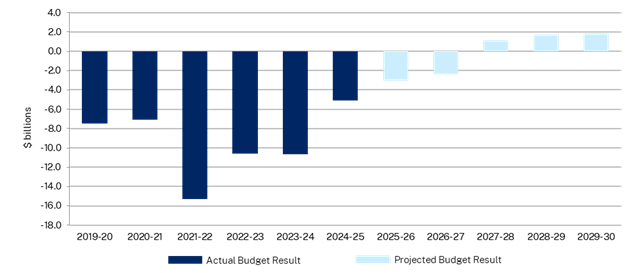
This year’s result reflects the global conditions facing NSW. Against a backdrop of higher fuel prices and ongoing uncertainty, a deficit of $2.3 billion is projected for 2026‑27.
Despite this, support for households continues, as does investment in essential services.
The Government has been able to provide this support because of the responsible decisions taken over the past three years to strengthen the state’s finances. We have put the Budget in a much stronger position by bringing spending growth under control.
The former government recorded a $15.3 billion COVID-19 deficit in 2021-22 and a $10.6 billion post-COVID splurge in 2022-23.
This Government brought expense growth down to 1.8 per cent last year and will hold it to an average of 2.7 per cent over the next four.
The 2025-26 deficit has come in at $3.0 billion – a $102 million improvement on the 2025‑26 Half-Yearly Review, and around $400 million better than forecast at last year’s Budget.
After the $2.3 billion deficit in 2026-27, the Budget then returns to a $1.1 billion surplus in 2027-28, the first since 2018-19.
It continues with surpluses of $1.8 billion and $1.9 billion in the two years after that.
Debt under control
Gross debt will be $178.5 billion by June 2026, almost $10 billion below the $188.2 billion the state was on track for under the previous government. Lower debt saves around $400 million a year in interest: money for essential workers and services, not lenders.
Real wages are growing again since March 2023, after falling over the previous government’s 12 years of wage caps.
There is more work to do. But NSW is back on track, and this Budget keeps building a state working Australians can afford: relief for today, reform for tomorrow, discipline always – supporting families, securing our future.
For more information, please see the NSW Budget website.