
GULF UPDATE: Trump Threatens Iran Blockade, Demands 20% “Collection Fee” for Hormuz Oil Ships
World News .News Aggregator using Gemini AI /Fact checking in the Newsroom
Posted 14 july,2026
DUBAI — The fragile peace in the Persian Gulf fractured dramatically as U.S. President Donald Trump announced the reinstatement of a naval blockade on Iran and declared that the United States would begin charging a massive 20% toll on commercial cargo transiting the Strait of Hormuz.
The sudden escalation follows a heavy exchange of missile and drone strikes between U.S. forces and Iran, effectively shattering an interim ceasefire deal meant to resolve the broader conflict.
“The Guardian of the Strait”
In a series of characteristic social media posts and a subsequent Fox News interview, President Trump declared that the U.S. military would take operational control of the world’s most critical maritime chokepoint.
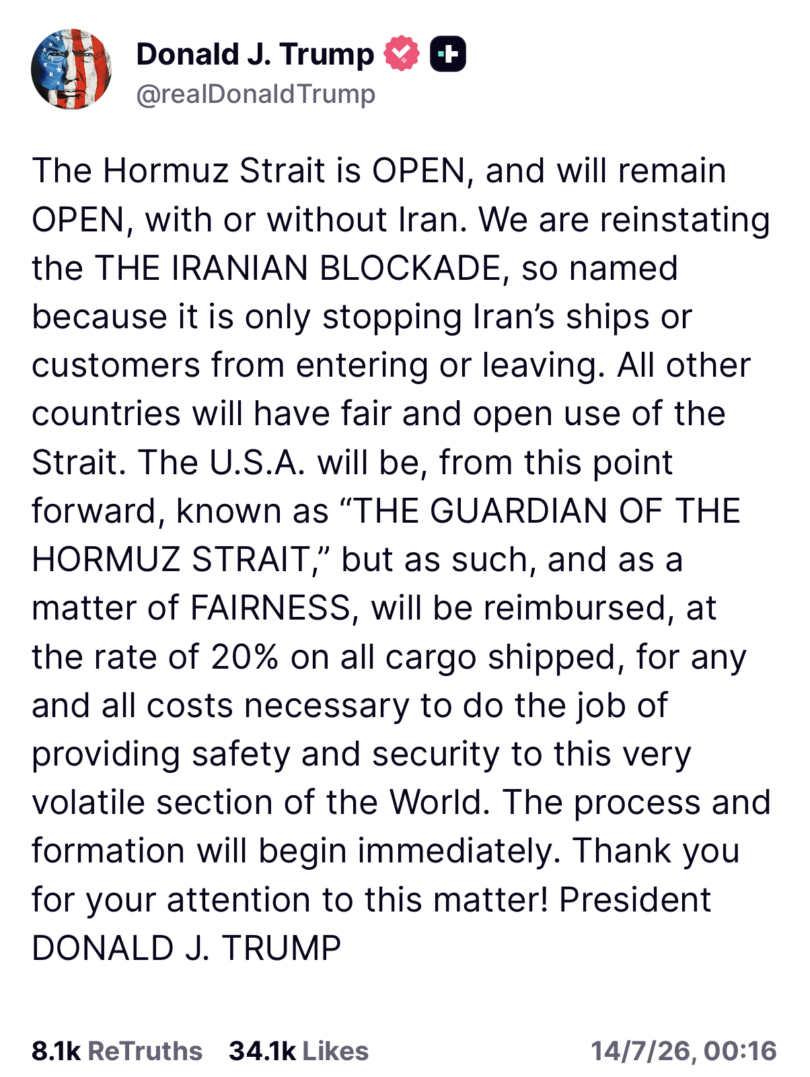
“The Hormuz Strait is OPEN, and will remain OPEN, with or without Iran,” Trump posted on Truth Social. “The USA will be, from this point forward, known as ‘THE GUARDIAN OF THE HORMUZ STRAIT,’ but as such, and as a matter of FAIRNESS, will be reimbursed, at the rate of 20% on all cargo shipped.”
Trump argued that the U.S. has provided free security in the region “for 50 years” without compensation. He asserted that the newly proposed 20% transit fee would be used to cover “any and all costs necessary to do the job of providing safety and security to this very volatile section of the World.”
Shortly after the announcement, the U.S. Navy-led Joint Maritime Information Center confirmed the blockade on Iranian shipping would begin immediately, warning that non-compliant vessels attempting to access Iranian ports could face interception and the use of force. Neutral shipping traveling to non-Iranian destinations along an expanded southern corridor near Oman will theoretically be permitted to pass—provided they pay the U.S. levy.
The Economic & Legal Shockwave
The prospect of a 20% American tariff sent immediate shockwaves through global energy and financial markets. Roughly one-fifth of the world’s liquefied natural gas (LNG) and oil passes through the narrow strait. Industry analysts warn that a 20% fee translates to an astronomical surcharge on global trade.
The unilateral move has drawn sharp international blowback, even exposing divisions within the U.S. administration. Just weeks prior, U.S. Secretary of State Marco Rubio explicitly stated that international law prohibits any nation from charging tolls on international waterways.
The United Nations’ shipping watchdog, the International Maritime Organization (IMO), swiftly rejected the proposal, stating it “stands firmly against charging fees for passage” and emphasizing that “there is no legal basis through which to introduce mandatory tolls simply to transit through a strait.”
Iran Responds: “20% is Too Much”
In Tehran, officials responded with defiance mixed with strategic irony. Iranian Foreign Minister Abbas Araghchi took to social media to state that Iran has been the true guardian of the strait “forever”.
However, in an unexpected twist, Araghchi mockingly agreed with Trump’s logic while rejecting his price point, posting:
“POTUS is absolutely right. Whoever provides secure and safe passage of commercial vessels through the Strait of Hormuz should be compensated for this service… 20% is of course too much. We will be fair.”
Prior to the U.S. announcement, Iran had been trying to establish its own permanent fee and permit system through a newly formed Persian Gulf Strait Authority. Iran’s Islamic Revolutionary Guard Corps (IRGC) warned that it views U.S. naval operations as illegal interference and threatened “severe disruption” for any ships transiting without Tehran’s authorization.
With both Washington and Tehran claiming exclusive rights to secure—and tax—the world’s most vital energy highway, commercial shipping fleets are left stranded in the middle of a highly volatile, multi-billion-dollar military standoff.