

Trump Vows to End Iranian “Blackmail” as Peace Talks Collapse, Orders Naval Blockade
International News Desk using Gemini Aggregator AI /Posted Tuesday 14 April,2026
WASHINGTON D.C. — President Donald Trump escalated his rhetoric against Tehran on Monday, declaring that the United States would no longer allow Iran to “blackmail or extort the world.” The statement follows the dramatic collapse of high-stakes peace negotiations in Islamabad, Pakistan, and marks a volatile new chapter in the ongoing conflict.
Speaking to reporters shortly after the breakdown of talks led by Vice President J.D. Vance, the President emphasized that the “only point that really mattered”—Iran’s nuclear program—remained the primary obstacle to a deal.
“We can’t let a country blackmail or extort the world because that’s what they’re doing,” Trump said. “They have chosen not to accept our terms. As long as they pursue nuclear ambitions, there will be no deal.”
The Blockade of the Strait of Hormuz
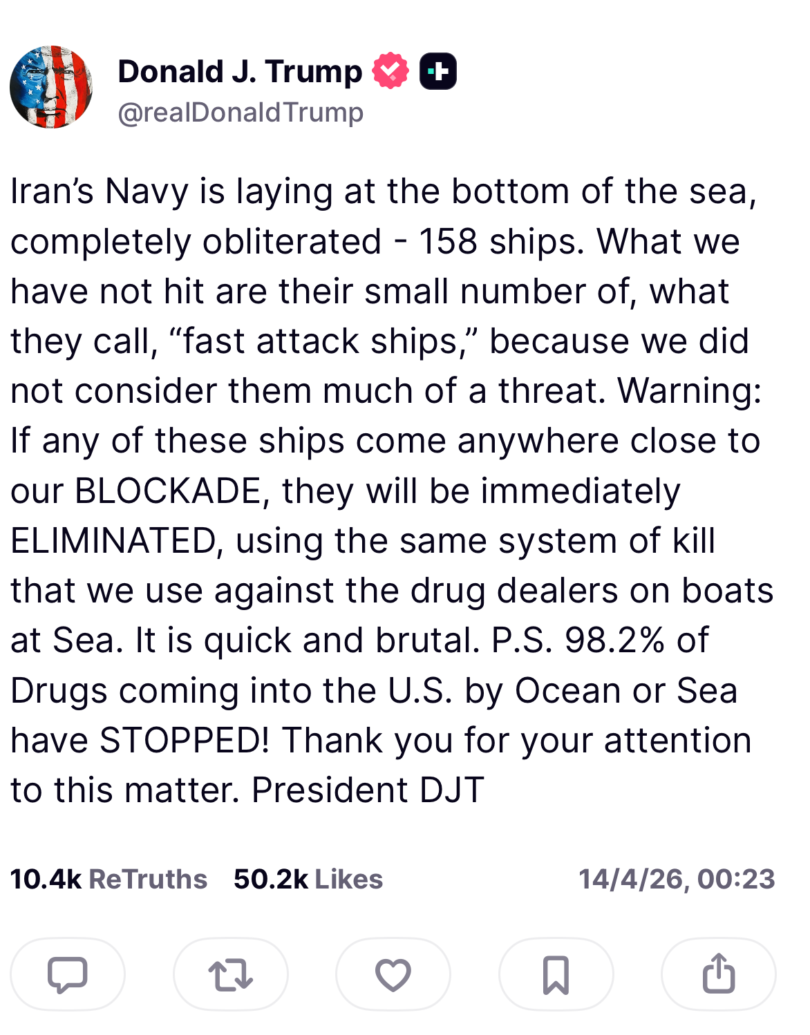
In a series of posts on Truth Social, the President announced he has instructed the U.S. Navy to begin a total blockade of the Strait of Hormuz. The move is intended to intercept any vessels entering or leaving Iranian ports and to interdict ships in international waters that have paid transit “tolls” to the Iranian regime, which Trump characterized as “international extortion.”
The blockade measures include:
-
Targeted Enforcement: U.S. Central Command confirmed the blockade will focus on vessels tied to Iranian trade, while maintaining passage for non-Iranian traffic.
-
Mine Clearing: The U.S. military has begun destroying mines reportedly laid by Iran throughout the Strait.
-
Strike Warnings: Trump warned that any Iranian forces firing upon U.S. or “peaceful” vessels would be “blown to hell.”
Failed Diplomacy in Islamabad
The escalation comes after 21 hours of marathon negotiations in Pakistan. Vice President Vance reported that while “most points” were agreed upon, the talks stalled permanently when Iran refused to provide an affirmative commitment to abandon its nuclear weapons program.
Iranian Foreign Ministry spokesperson Esmaeil Baqaei countered that the U.S. was making “excessive demands” and cited American “maximalism” as the reason for the deadlock. Iran had reportedly sought the release of $6 billion in frozen assets and the right to maintain its influence over the Strait of Hormuz as part of the ceasefire terms.
Global Market and Political Reaction
The prospect of a long-term blockade in the Strait of Hormuz—the world’s most critical oil chokepoint—sent shockwaves through global energy markets. Brent Crude prices surged in early trading as analysts warned that the blockade could be interpreted by Tehran as a formal act of war, potentially ending the fragile two-week ceasefire.
On Capitol Hill, the reaction was sharply divided. Democratic leaders, including Senator Chuck Schumer, condemned the President’s recent threats to target Iranian civilian infrastructure, calling the rhetoric “reckless.” Meanwhile, administration officials maintained that the “Midnight Hammer” strikes last June, which targeted nuclear sites in Fordo and Natanz, proved the U.S. is committed to a “denuclearized Iran at any cost.”
As of Monday evening, the White House has left the door open for a “final and best offer,” though the President’s tone suggests that for now, the era of diplomacy has been replaced by one of maximum naval pressure.