
“They Weren’t There For Us”: Trump Rages at Australia and NATO as Allies Balk at Iran Conflict
World News Aggregator/Sydney Times NewsDesk
Posted 18 April,2026
WASHINGTON D.C. — Fresh off his announcement that the Strait of Hormuz has been “reopened,” President Donald Trump has turned his sights toward America’s traditional allies, launching a scathing critique of Australia and NATO for what he describes as a betrayal of the U.S. in the Middle East.
In a series of remarks from the White House and on Truth Social this week, the President claimed that while the U.S. has spent decades protecting its partners, those same nations “went missing” when he asked for military assistance against Iran.
The “Test” of the Strait
The President explicitly labeled the recent military operations to reopen the Strait of Hormuz as a “test” for the Western alliance—a test he says they failed.
“I’m not happy with Australia because they were not there when we asked them to be there,” Trump told reporters on Thursday. “They were not there having to do with Hormuz… I was a little bit surprised that they said no, because we always say yes to them.“
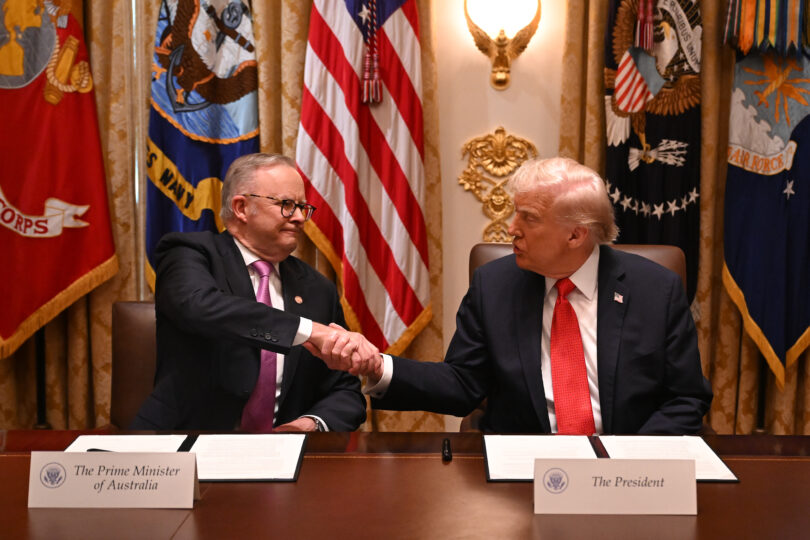
The criticism comes despite Australian Prime Minister Anthony Albanese and Defence Minister Richard Marles insisting that there was “no specific request” from the White House for Australian warships to join the naval blockade. Australia has maintained a presence in the region with a Wedgetail surveillance aircraft, but the President dismissed this as insufficient, signaling a deep rift in the AUKUS partnership.
NATO: The “Paper Tiger”
The President’s rhetoric toward Europe was even more severe. In a bombshell interview with The Telegraph earlier this month, Trump described NATO as a “paper tiger” and claimed he is “seriously considering” a total U.S. withdrawal from the 77-year-old alliance.
“I always knew they were a paper tiger, and Putin knows that too,” Trump said. “It was a test… we were there for them with Ukraine, which wasn’t even our problem. But they weren’t there for us.”
Key Points of Contention:
-
The 5% Target: Trump is reportedly pushing for a new defense spending benchmark of 5% of GDP for all allies—a massive leap from the current 2% target that many European nations and Australia (at ~2.1%) only recently reached.
-
Refusal of Overflights: The administration was particularly incensed by Spain and other European allies refusing U.S. military overflights related to the Iran conflict.
-
Strategic Autonomy: European leaders have responded by speeding up plans for “common purchases” and independent military manufacturing, fearing that the U.S. security umbrella is effectively folded.
A Muddled Diplomatic Future
The timing of the criticism is peculiar to many observers, as it coincides with the reopening of the Strait of Hormuz and the potential for a “Grand Bargain” with Tehran. However, analysts suggest the President is using the moment to redefine the terms of American alliances.
By maintaining a naval blockade on Iranian ships while allowing commercial traffic, Trump is essentially telling allies that they will benefit from the “Peace Strait” he secured, but will remain “on the hook” for the costs of security.
In Canberra, the opposition has labeled the contradiction between U.S. and Australian accounts as “very unfortunate,” while the Albanese government has attempted to downplay the friction, stating they will “not get into a running commentary” on the President’s remarks.
As the 60-day window for peace negotiations with Iran begins, the question remains: if a deal is reached, will it be a victory for a new “America First” coalition, or the final crack in the post-WWII global order?