
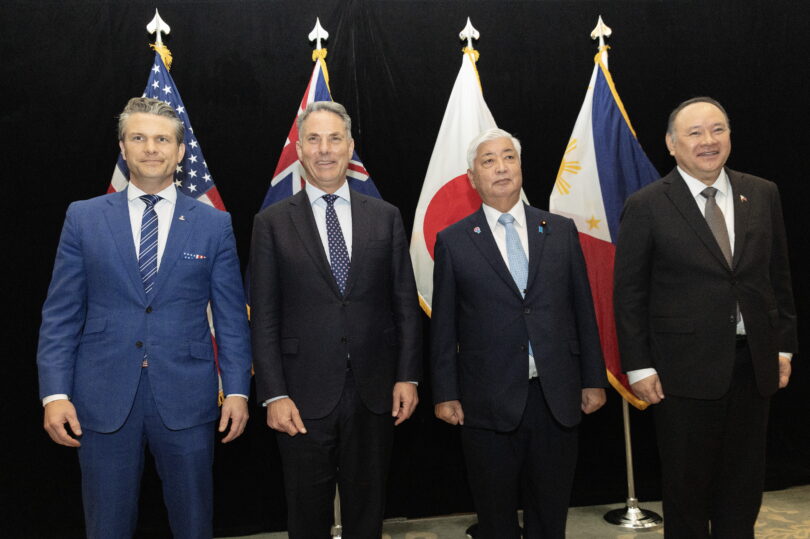

AUKUS Shakeup: Australia Pivots to All-Second-Hand US Sub Fleet to Cut Costs and Complexity
International News content Generated with Gemini AI /Fact checking in the Nedwsroom
Posted Monday 01 June 206
SINGAPORE — The federal government has overhauled the initial phase of the historic AUKUS pact, announcing that Australia will abandon plans to buy a newly built American nuclear submarine and will instead purchase three second-hand vessels.
Speaking from the Shangri-La Dialogue defense summit in Singapore, Defense Minister Richard Marles revealed that acquiring three “in-service” Virginia-class submarines from the United States Navy would deliver significant financial savings and dramatically reduce operational headaches.
Under the original framework, the Royal Australian Navy was slated to receive a mix of two used vessels and one brand-new, modified variant straight off the production line in the early 2030s.
Placing a Premium on Simplicity
Mr. Marles stated that the trilateral agreement between Australia, the US, and the UK remains “incredibly complicated,” making any logistical streamlining highly valuable.
He warned that the previous stopgap strategy would have forced Australia to manage up to four distinct submarine types simultaneously:
-
The aging, domestic Collins-class diesel-electric fleet.
-
Refurbished US nuclear vessels.
-
A newly built US nuclear model.
-
The future custom-designed SSN-AUKUS fleet.
-
In the context of a very complicated endeavor, we need to place a premium on simplicity,” Mr. Marles told reporters. “What we will have here is a much simpler pathway. It will mean that the Virginia-class submarines that we are acquiring will all be of the same type.”
He emphasized that standardization would provide a massive relief for both the crews operating the vessels and the domestic workforce tasked with maintaining them at HMAS Stirling in Western Australia.
Sidestepping US Supply Chains
The policy pivot comes amidst ongoing pressure on the US defense industrial base. American shipyards have struggled to meet their own production targets of building two new Virginia-class submarines a year, sparking intense debate among US lawmakers about Washington’s capacity to supply an ally without gutting its own fleet.
By pivoting entirely to existing, in-service American stock, Canberra side-steps the bottleneck of US factory lines while ensuring a smoother transition window before the Collins-class fleet is completely decommissioned.
While the exact dollar amount remains undisclosed, Mr. Marles confirmed the savings generated from the change would be “significant.”
“It is definitely cost-effective,” Mr. Marles said. “And to be clear, this is a very expensive program… so we are trying to find every cost-effective option as we walk down this path.”