

Albanese Government Commits “Defensive” Military Support to Gulf as Middle East Conflict Widens
CANBERRA – Prime Minister Anthony Albanese has officially committed Australian military assets to the Middle East, announcing the deployment of a high-tech surveillance aircraft and advanced missile systems to assist Gulf states currently under fire from Iranian drone and rocket strikes.
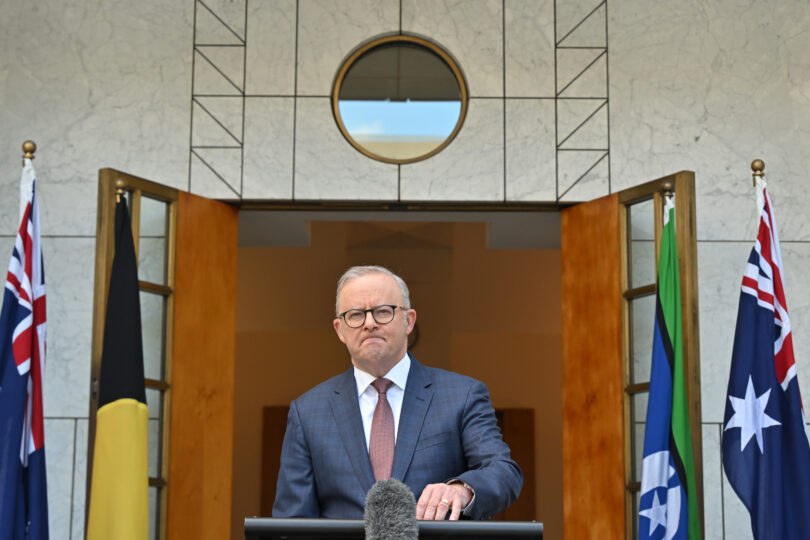
Speaking from Parliament House on Tuesday morning, the Prime Minister framed the mission as a “strictly defensive” measure intended to protect civilian infrastructure and the estimated 115,000 Australians still in the region.
A High-Tech Shield
The centerpiece of the commitment is the deployment of a Royal Australian Air Force (RAAF) E-7A Wedgetail. One of the world’s most advanced airborne early-warning and control aircraft, the Wedgetail will provide long-range reconnaissance to help secure the airspace over the Gulf.
In addition to the aircraft, Australia will provide:
-
AMRAAMs: Advanced Medium-Range Air-to-Air Missiles sent to the United Arab Emirates (UAE).
-
Personnel: Approximately 85 ADF personnel to operate and support the Wedgetail.
-
Duration: An initial four-week deployment, with the aircraft expected to be operational by the end of this week.
“The first priority of my government is, and always will be, to keep Australians safe,” Mr. Albanese said. “Helping the UAE and other Gulf nations to defend themselves against unprovoked attacks is a key part of that.”
Drawing a “Red Line” on Offensive Action
The announcement follows weeks of escalating tensions after US and Israeli strikes on Iranian targets triggered a massive retaliatory response. The UAE alone has reportedly intercepted over 1,500 drones and missiles in recent days.
Despite the deployment, both the Prime Minister and Foreign Minister Penny Wong were careful to distinguish this mission from past Middle Eastern conflicts.
“This is not Iraq, and we are not the Howard government,” Senator Wong told reporters. “We are not asking Australians to accept men and women being deployed into a ground war.”
The government has explicitly ruled out:
-
Ground troops on Iranian soil.
-
Offensive strikes against Iranian targets.
-
Participation in the direct US-Israeli war effort against Tehran.
Domestic and Legal Friction
While the Coalition has offered tentative support for “duly considering” the requests, the move has drawn sharp criticism from the Australian Greens. Greens Senator David Shoebridge accused the government of “signing Australia up to another US forever war by deception,” arguing that the deployment of tactical assets like the Wedgetail frees up US resources for offensive strikes.
International law experts have also warned that providing military hardware and personnel—even for defensive purposes—could technically make Australia a party to an “international armed conflict” under Article 51 of the UN Charter.
Economic and Consular Crisis
The conflict has already sent shockwaves through the Australian economy, with Brent crude prices remaining volatile and air travel disrupted.
The Department of Foreign Affairs and Trade (DFAT) continues to manage a massive consular operation. While more than 2,600 Australians have returned home on government-supported flights, tens of thousands remain. The government has urged any citizen remaining in the region to take available seats on commercial or repatriation flights immediately as the security situation remains “highly unpredictable.”