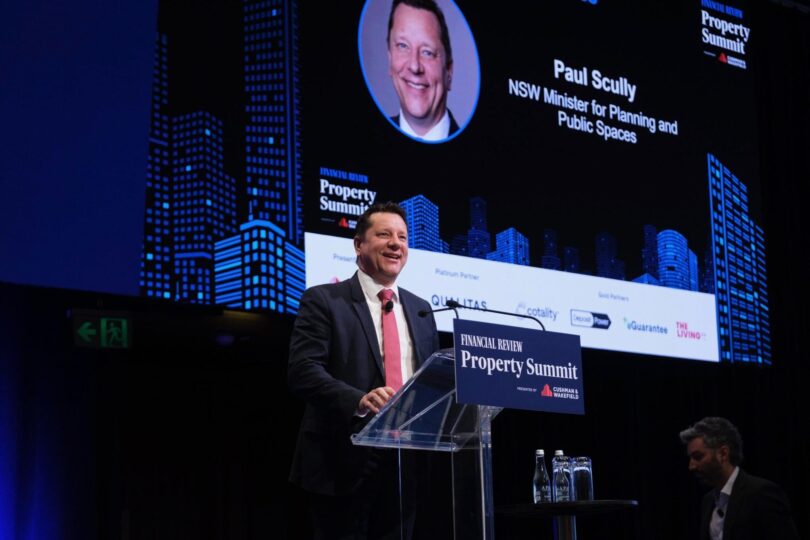


ADDRESS TO THE AUSTRALIAN FINANCIAL REVIEW PROPERTY SUMMIT 2025
THE HILTON, SYDNEY
MONDAY, 1 SEPTEMBER 2025
Media release
PAUL SCULLY
MINISTER FOR PLANNING AND PUBLIC SPACES
Some of you may recall that in 2021, the ‘Housing Theory of Everything’ policy paper was published in the UK online magazine ‘Works In Progress’.
It proposed that housing shortages don’t just prevent people from affording their own home, they drive inequality, climate change, low productivity growth, obesity, and even falling fertility rates.
And it issued the following challenge: try listing every problem the Western world has now.
The one big thing that makes them all worse is a shortage of housing.
And if we fix that shortage, we will help to solve many other, seemingly unrelated problems as well.
Which brings me to some of the questions that the Summit is posing:
How do we invest for growth? What are the most practical solutions to the housing crisis? Where and how to find finance?
And will fast-growing alternatives such as data centres, rental housing, and healthcare facilities continue to hold appeal?
Today I want to address these questions through the prism of planning – our very own planning theory of everything, if you like.
I sometimes joke with the Treasurer, Daniel Mookhey, that the planning portfolio is way more powerful than Treasury, because with the stroke of a pen planning can massively change the value and purpose of land.
The Treasurer by contrast only has a finite amount of cash to play with.
My point is the planning system has an immense social, economic and environmental responsibility in our society.
It influences where people live and work, where they can play and picnic.
Whether we want to live in a terrace or a tower, that housing type must be permissible under the planning system.
And it can produce more than built form outcomes.
A 90-minute commute each way for a healthcare worker from Penrith to a hospital in Central Sydney each day, is time that could be spent with the family or cooling off at Penrith Beach.
If homes are not built near existing transport and jobs, affordability decreases, productivity reduces and living standards decline.
“Put simply – planning must consider competing demands, and poorly planned cities create poor outcomes for communities which, if not recognised can end up lowering the standard of living for some while raising it for others.”
And when you consider that over ninety percent of the housing delivered in NSW is delivered by the private sector, the incentives, zonings and approvals have a direct impact on economic activity and value.
Let me outline the problems we’re confronting, share some of the tensions and get to the measures we’ve put in place to address them.
The last decade left our State with a global silver medal no one wants.
NSW has become the second least affordable city in the world.
And between 2016 and 2021, Sydney lost 35,000 people aged 30-40.
We’re now the 859th least dense city in the world.
Since 1992, NSW has built six dwellings per 1,000 residents on average.
At the same time, Victoria and Queensland built around 8 and 9 per 1,000 respectively.
And it’s one thing to get houses approved – it’s another to gain financing, build and complete them.
If the undersupply of housing wasn’t a big enough challenge, we also face challenges with the availability of zoned and serviced industrial land.
In the early 2010s, we stood on the precipice of one of the largest industrial transformations the world had seen in decades.
The shift from fossil fuels to renewable energy has seen trillions of dollars invested around the world and the economic, productivity and labour implications of this transition cannot be overstated.
But a lack of leadership on renewables in NSW, has meant our State has been playing catch up in a global race.
Opposition to this shift from local political leaders meant that we have not adequately engaged with or shared the benefits with local communities.
Now the world is facing another transition. One that is moving at a far greater speed than renewables ever did.
The future of Artificial Intelligence is on everyone’s mind.
We must come to terms with the productivity, infrastructure and labour market implications so NSW is not on the backfoot again.
Our broader economy is now dependent on the information economy which in turn relies on data exchange and management.
That management is via data centres which need their own space, and their own resources.
All the issues I’ve just mentioned and more – including the preservation of our environment – are all considered through the planning system and the competing interests it seeks to balance in the long-term collective interest.
In summary, we need more housing; we need to encourage the fourth industrial revolution, we need to rebuild our energy system and improve the environment and the planning system must go faster.
So, what have we done and what are we doing?
First, we brought the planning system under one Minister, instead of five.
We then set about some of the biggest planning reforms in NSW history.
Our Transport Oriented Development program and Low- and Mid-Rise housing policy will allow 282,000 homes to be built in the coming years.
The new Housing Delivery Authority has so far seen over 79,000 new homes directed to a state significant pathway for approval.
We introduced a pattern book of architect led designs with a 10-day approval pathway and we’ve sold over 12,000.
We’re fixing the digital systems that support it which were clunky, slow and not at all user friendly when we took office.
We’ve introduced Council league tables and published our own performance, so performance is plain for all to see. Especially me.
And while it takes time for planning reforms to take effect, lodgements and building approvals are up, with State Significant Development Applications making up much of this improvement.
Which raises the question: with more homes coming through, can we speed up assessments and retain assessment quality given that we have a shortage of experienced planners?
Part of our efforts to reform the digital system have been to not just replace a paper system with the same version of it online but to truly integrate digital tools into the planning system.
And today I can announce that the NSW Government has issued a tender for an artificial intelligence solution to assess State Significant Development applications.
I want that solution to be one up and running quickly.
We will require that the technology has demonstrated a capacity to:
- complete an intelligent review of documentation prior to lodgement.
- accurately assess an application against a required criterion and reduce timeframes in assessment.
- and be able to complete post-submission checks.
By implementing Artificial Intelligence, we hope to slash assessment timeframes on major residential developments while keeping a human as the final decision maker.
This program will build on our Government’s existing grant program which allows councils to trial AI solutions in their local planning systems.
And today’s announcement means NSW is the only state to be adopting AI for larger scale developments.
While there are arguments about the impact of AI in our society, this is an obvious use, making routine checking and assessment, precise and quick so that a human makes a final decision.
But as everyone in this room knows, you can’t live in an approval.
We have to translate approvals to build and from construction to completions.
In the last 5 years, the time between approval and commencement of new apartments has increased 39%, from 5.6 months to 7.8 months and we have around 15,000 developments approved but not commenced.
The pre-sale requirement to secure financing has increased in some cases to 80 per cent of the dwellings in a project.
If a builder can only sell 50 per cent of pre-sales, they must either secure the shortfall another way or wait.
This results in delays no one can afford.
So, we’re introducing a world-leading $1 billion Pre-sale Finance Guarantee.
Using the NSW Government’s strong balance sheet the Government will commit to the purchase of up to 50 per cent of a development with an aggregate value of between $5 – $50 million.
Eligible builders will be able to start construction sooner while continuing to sell dwellings off-the-plan and can extinguish the guarantee at any point.
If the builder calls on the guarantee, the Government will buy the homes at a discounted rate, once they’re built.
They can then be rented, offered to a Community Housing Provider or sold into the market.
Either way, we see homes built and keys in doors.
We expect the program to be open for Expressions of Interest soon, so builders can access the Guarantee by the end of this year.
Now as we help build more homes, I have an expectation that we deliver the jobs and economic growth alongside it.
Businesses report barriers to making capital investments in NSW.
This is due to the difficulty of coordinating with a raft of State agencies, getting the relevant regulatory approvals, and securing the enabling infrastructure.
There is currently no mechanism for systematically identifying major projects before they enter the planning system.
The Minns Government wants to encourage major investment proposals and consider their associated land use at the same time.
That way the proposals can be fast-tracked for assessment and the necessary infrastructure and agency examination can be coordinated to deliver them.
If you look at just one burgeoning industry – data centres – NSW is already leading Australia and is one of the leaders in the world.
We have 90 data centres approved and another 20 under assessment, but we need to do more so the world knows NSW is investment ready.
Given the uncertainty that surrounds the current global trade environment and the resources and conditions offered here Australia is a strong contender for greater international investment and we want NSW to be the first place that people think of when looking for good options for global capital – both financial and human.
So, we have created the Investment Delivery Authority.
Led by the Treasurer, me, and the Minister for Industry and Trade, it will run an EOI process for investments in priority industries that align with our trade and industry policies with a capital investment value of $1 billion and assess them as State Significant Development.
It will be the front door to NSW for investment, and it will be open for domestic and international investors later this year.
It will work in tandem with our Industrial Land Policy which is set to be finalised later this year as well.
Industrial industries and activities contribute approximately $174 billion in gross value to the NSW economy in 2024 alone.
And there has been $14.8 billion worth of private development in the pipeline across the Western Sydney Aerotropolis.
Our policy will deliver a simpler approach for the pipeline of industrial lands, replacing outdated policies, at an important time.
As that work continues, we are pressing on with important and economically significant work around industrial land including the rezoning of 200 hectares of surplus, serviced and accessible industrial land adjacent to the Port Kembla steelworks – the revitalisation of industrial land on a globally significant scale.
Everything I’ve talked about today is about how we are grappling with competing and urgent land uses due to societal need and change.
Our response to these changes can’t be a luddite smashing.
We must grow because that’s how we have always driven prosperity, and security and built one of the best places in the world to live.
But I want to conclude by emphasising perhaps the most urgent of those needs – housing.
Quite frankly, we run the risk of continuing to accept a kind of housing segregation.
By that I mean we have allowed a system to develop over time that has created an almost systematic and institutionalised resistance to expanding housing supply.
There are already areas of Sydney that are pushing back so hard on increasing supply, that they are becoming exclusive areas due to their lack of affordability, the high cost to travel to them and their resistance to change.
Their voices are loud, and they drown out the voices of future generations.
They are almost actively vying to become the first suburbs without children, let alone grandchildren as a result of exclusion by expense.
And the great irony of this position is that as those communities age, they need services to support them that range from health care to home maintenance.
Not only is it unreasonable to expect people to travel long distances to provide those services, but already many can’t due to time and cost and a personal sacrifice outweighed by the household income it might return.
So, we must keep prosecuting the argument for more supply.
The debate is not over.
We must not accept that somehow there are communities that can be shielded from change.
In short all of Sydney needs to be a place where we all have a place to live.