
The Carney Doctrine: Canada and Australia Forge a New Strategic Front in Canberra
News Aggregator Post Wednesday,04 March,2026
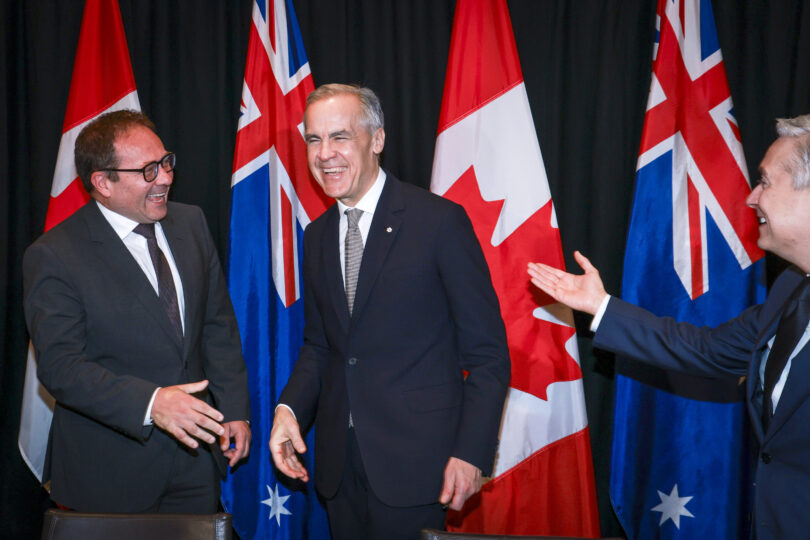
CANBERRA – In a visit marked by strategic urgency and a departure from traditional diplomacy, Canadian Prime Minister Mark Carney and Prime Minister Anthony Albanese have codified a new “Middle Power” alliance, positioning their nations as a unified front in an increasingly fractured global landscape.
The visit, centered on high-level talks at Parliament House and a pivotal keynote address at the Lowy Institute, signaled that the Canada-Australia relationship has moved beyond Commonwealth sentimentality into a pragmatic, security-driven partnership.
The “Failure of Order”: A Call to Arms at Lowy
The centerpiece of the visit was Carney’s address at the Lowy Institute, where he delivered a blunt assessment of modern geopolitics. Addressing recent strikes in the Middle East and the shifting influence of traditional superpowers, Carney described the current state of affairs as a “failure of the international order.””International law binds all belligerents, yet we see actions taken without the consultation of traditional allies,” Carney stated. “Canada and Australia cannot passively wait for a world we wish to be; we must actively take on the world as it is.”
The Prime Minister balanced this critique with a pragmatic “world as it is” approach, supporting the need to prevent a nuclear-armed Iran while calling for a “rapid de-escalation of hostilities.”
AUKUS Pillar II: Canada Steps In
A major reveal during the visit was Canada’s formal alignment with AUKUS Pillar II. Carney clarified that Canada is no longer a bystander in Indo-Pacific security architecture, specifically highlighting Canadian strengths in Artificial Intelligence, quantum computing, and undersea surveillance.
As a “down-payment” on this technical collaboration, the leaders finalized a deal for Canada to purchase an Australian-developed over-the-horizon radar system to bolster security in the Arctic—a move that effectively integrates the two nations’ defense technical capabilities.
The $1.5B Critical Minerals “Buyer’s Club”
Turning to economic security, the leaders announced the Canada-Australia Critical Minerals Strategic Partnership. This landmark agreement includes a $1.5 billion “First and Last Mile” Fund designed to insulate both nations from global supply chain shocks.
-
Premium Standards: The pact creates a “High-Standards Producer” framework for lithium, nickel, and rare earths, distinguishing their products from less regulated markets.
-
Joint Infrastructure: Australian raw materials will be paired with Canadian advanced chemical refinement, creating a “closed-loop” supply chain that secures the future of the battery and defense sectors.
A Commonwealth Counterweight
The visit concludes with the signing of a memorandum of understanding to advocate for the expansion of the CPTPP, including a push to bring the European Union into the trade bloc. For Prime Minister Albanese, the rapport with Carney provides a vital diplomatic counterweight as Australia navigates regional tensions and an unpredictable global political climate.
“Australia is a natural partner,” Carney told reporters outside Parliament House. “We are pulling our resources to ensure the technologies and rules of the future are governed by those who respect the order.”
-At the Table, Not on the Menu: Mark Carney’s Lowy Institute Power Play
In a landmark visit signaling a new era for “middle power” diplomacy, Canadian Prime Minister Mark Carney arrived in the nation’s capital today to meet with Prime Minister Anthony Albanese, reinforcing a strategic alliance increasingly defined by shared security concerns and economic resilience.
The visit, the first by a Canadian leader in over a decade, was anchored by a high-stakes keynote address at the Lowy Institute in Sydney on Wednesday, followed by formal bilateral talks and an address to the Australian Parliament in Canberra.
The Lowy Speech: ‘Failure of the International Order’
Speaking to a packed room of diplomats and policy experts at the Lowy Institute, Prime Minister Carney delivered a sobering assessment of global stability. Amidst escalating conflict in the Middle East, Carney issued a pointed statement on the “failure of the international order,” specifically addressing recent U.S. and Israeli strikes on Iran.
“The current conflict is another example of the failure of the international order,” Carney stated. “Canada reaffirms that international law binds all belligerents, yet we see actions taken without the consultation of the UN or traditional allies.”
Carney balanced this critique with a pragmatic “world as it is” approach, supporting the need to prevent a nuclear-armed Iran while calling for a “rapid de-escalation of hostilities.” The speech resonated with the Australian audience, reflecting a shared anxiety over the volatility of traditional superpowers and the need for middle powers like Canada and Australia to “pull their resources” to maintain a rules-based system.
Albanese and Carney: A ‘Natural Partnership’
Following the Sydney address, Carney traveled to Canberra for a series of meetings with Prime Minister Anthony Albanese. The two leaders, who share a noted personal rapport, focused on three primary pillars of cooperation:
-
Critical Minerals: A new agreement was discussed to secure supply chains for battery and energy sectors, leveraging Western Australia’s resource wealth and Canada’s processing capabilities.
-
Arctic & Indo-Pacific Defense: The leaders finalized a deal for Canada to purchase an Australian-developed over-the-horizon radar system for use in the Arctic, a significant move in deepening technical defense ties.
-
CPTPP Expansion: Carney sought Albanese’s support for a “grand bargain” to bring the European Union into the Comprehensive and Progressive Agreement for Trans-Pacific Partnership (CPTPP), aiming to create a massive trading bloc that sidesteps current Washington-Beijing frictions.
A Shift in Focus
The visit marks a definitive shift in Canada’s foreign policy under Carney, moving Australia from the “back burner” to a primary strategic partner. For Albanese, the meeting provides a vital Commonwealth counterweight as Australia navigates its own regional challenges with China and an unpredictable U.S. political landscape.
“Australia is a natural partner for Canada,” Carney told reporters outside Parliament House. “We are middle powers who are actively taking on the world as it is, not passively waiting for a world we wish to be.”