
SUNSCREEN SHOCK: 16 OF 20 POPULAR BRANDS FAIL SPF TEST, TGA LAUNCHES MAJOR INVESTIGATION
From a Media Release by CHOICE /Post refreshed on 15 october,2025
SYDNEY – Australian consumers have been warned to be vigilant this summer after a bombshell investigation by consumer advocacy group CHOICE found that the majority of popular sunscreens are failing to deliver the level of protection advertised on their labels.
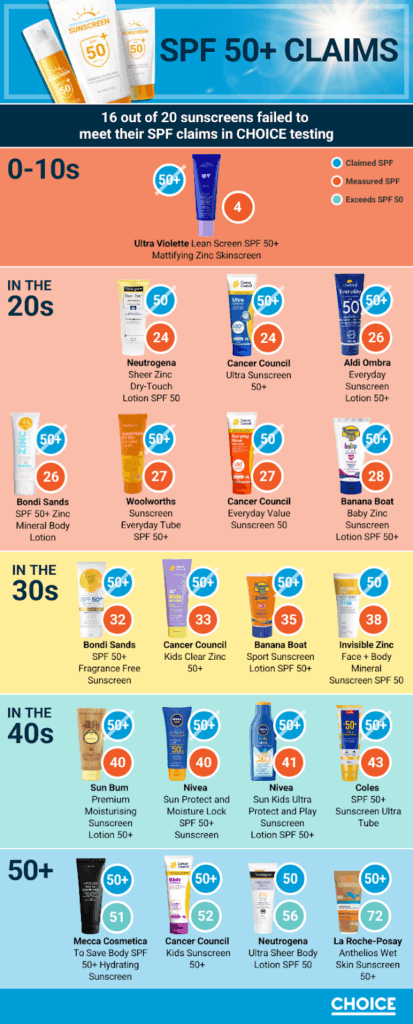
Out of 20 sunscreens claiming an SPF (Sun Protection Factor) of 50 or 50+, a staggering 16 products failed to meet their stated claims in independent laboratory testing. The failures ranged from minor underperformance to a catastrophic result that offered virtually no effective protection.
The findings, first released in June and now the subject of an intense regulatory review, have prompted the Therapeutic Goods Administration (TGA) to issue a consumer alert regarding a specific base formulation used across multiple brands.
Worst Performer Tested at SPF 4
The most alarming result of the investigation belonged to Ultra Violette Lean Screen SPF 50+ Mattifying Zinc Skinscreen, which, in CHOICE’s testing, returned an SPF of just 4. This result was so low that CHOICE conducted a follow-up test at an international laboratory, which returned a near-identical SPF of 5.
Following the public backlash and the contradictory nature of their own internal data, Ultra Violette voluntarily removed the product from sale and offered refunds in late August.
CHOICE CEO Ashley de Silva called the findings “pretty shocking,” especially for a product claiming “Very High” protection.
Other well-known brands that failed to meet their SPF 50 claims by a significant margin included:
- Cancer Council Ultra Sunscreen 50+: Tested at SPF 24
- Aldi Ombra Everyday Sunscreen Lotion 50+: Tested at SPF 26
- Banana Boat Baby Zinc Sunscreen Lotion SPF 50+: Tested at SPF 28
- Bondi Sands SPF 50+ Fragrance Free Sunscreen: Tested at SPF 32
TGA Expresses Concern Over Base Formula
In September, the TGA escalated its response, announcing a full investigation and raising concerns about a shared base formulation common to the worst-performing products. The TGA noted that preliminary testing indicated this base formulation was “unlikely to have an SPF greater than 21” in at least some finished goods.
The regulator is also investigating the reliability of a UK-based testing laboratory, Princeton Consumer Research Corp, which provided initial SPF certification for several of the failed products.
Despite the industry-wide turmoil, four products did pass the rigorous testing and met or exceeded their SPF claims, including the La Roche-Posay Anthelios Wet Skin Sunscreen SPF 50+, which tested highly at SPF 72.
Brands Defend Claims
Manufacturers of the failed sunscreens have largely disputed CHOICE’s results, standing by their own TGA-compliant test certificates. Many brands argue that sunscreens are registered as therapeutic goods and undergo mandatory testing by accredited labs before being listed on the Australian Register of Therapeutic Goods (ARTG).
However, CHOICE maintains that while SPF testing is known to be variable (as it relies on human subjects), the dramatic discrepancy between claimed SPF 50+ and tested SPFs in the single digits is unacceptable.
Consumer Advice: CHOICE and the TGA both advise consumers not to stop using sunscreen. Even products testing lower than their claim (e.g., SPF 30) still offer high protection. Consumers are strongly urged to continue practising the five pillars of sun safety: Slip, Slop, Slap, Seek, Slide .
The TGA’s investigation is ongoing, and further regulatory action, including potential product recalls, is expected in the lead-up to the summer peak.
You can see more details on the initial findings in this report: CHOICE finds popular sunscreens fail to meet SPF claims | ABC NEWS.