
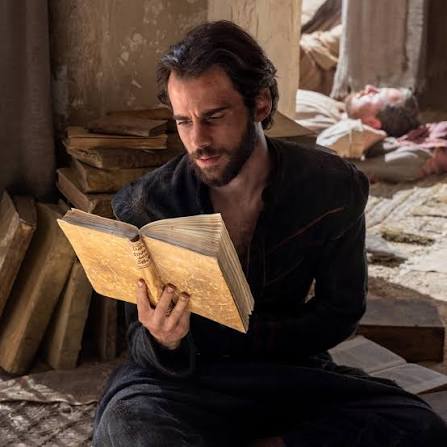

Spanish and South American Festival Spotlight: The Captive (El Cautivo)
Film Review by A.Ritenis/Formatting Gemini AI /Posted 08 June,2026
Director: Alejandro Amenábar
Cast: Julio Peña Fernández, Alessandro Borghi, Miguel Rellán, Fernando Tejero
Runtime: 134 minutes
Language: Spanish, Arabic, and Italian (with English subtitles)
One of the most anticipated titles at this year’s HSBC Spanish & Latin American Film Festival at Palace Cinemas is The Captive (El Cautivo), an ambitious, handsomely staged historical drama from Oscar-winning director Alejandro Amenábar (The Sea Inside, The Others). Rather than delivering a conventional, cradle-to-grave literary biopic of Spain’s grand icon Miguel de Cervantes, Amenábar zeroes in on a harrowing, fertile, and deeply transformative five-year vacuum in the author’s youth: his imprisonment in Ottoman Algiers starting in 1575.
The result is a dense, sumptuously shot, and fiercely debated exploration of trauma, cultural fluidity, and the physiological necessity of narrative. It positions storytelling not as a leisurely artistic pursuit, but as a literal currency for survival.
The Plot: A Genius in Chains
The film opens in 1575 with a young, broken Miguel de Cervantes (played with anchored, intense vulnerability by Julio Peña Fernández). At just 28 years old, he is a Spanish Navy soldier returning from the Battle of Lepanto, bearing a maimed left arm that renders him largely useless as a physical laborer. When his galley is seized by Ottoman corsairs, he is brought to the notorious Bagno prison of Algiers to be sold into slavery.
Faced with a ticking clock—and a cruel execution if his destitute family back home fails to raise a steep ransom—Cervantes inadvertently saves his own neck by brandishing a letter of recommendation from King Philip II of Spain. Believing him to be a high-ranking nobleman of immense political value, his captors throw him into a high-stakes limbo alongside clergymen, scholars, and aristocrats.
It is within these claustrophobic, sweat-drenched cells that Cervantes discovers his true weapon. To keep despair and madness at bay, he begins weaving sweeping, imaginative tales of escape for his fellow prisoners. These theatrical mid-cell recitations soon catch the ear of Hasan Pasha (Alessandro Borghi), the enigmatic, hedonistic, and psychopathically volatile Bey of Algiers. What follows is a high-wire, One Thousand and One Nights dynamic: Cervantes trades captivating stories for days of supervised freedom in the teeming markets, barber shops, and hammams of Algiers, initiating a complex psychological chess match between captor and captive.
Directorial Vision and Cultural Multiplicity
Amenábar, who wore multiple hats for this passion project—writing the script, directing, and composing the sweeping orchestral score—treats history not as a static museum exhibit, but as a fluid, psychological playground. Visually, the film relies heavily on stark contrasts. The first half is defined by the grimy, tight-angled, oppressive realism of the Algiers slave prisons, brilliantly capturing the shared agony of the captives.
However, once Cervantes earns his brief sunlit reprieves, the cinematography explodes into a textured, deeply immersive portrait of 16th-century North Africa. Rather than reducing the Ottoman Empire to a monolith of historical villainy, Amenábar frames Algiers as a dazzling, cosmopolitan crossroad of language, religion, and shifting power structures.
The Metafictional Layer: The film’s true triumph is how it maps the building blocks of Don Quixote. Audiences watching closely will notice fellow captives—such as Miguel Rellán’s scholarly priest, Antonio de Sosa—gradually morphing in Cervantes’ subconscious into the architectural blueprints for Don Quixote and Sancho Panza. It beautifully argues that Spain’s greatest novel wasn’t born in comfort, but was forged in the agonizing gap between who Cervantes was and who captivity forced him to become.
Performances and the “Queering” of the Canon
The emotional gravity of the film rests squarely on the shoulders of Julio Peña Fernández. Best known previously for teen romances, Peña delivers a revelatory, star-making performance that earned him Best New Actor honors at the Cinema Writers Circle Awards. He balances a boyish optimism with the hollowed-out look of a combat veteran, ensuring Cervantes remains humanly fragile rather than mythically untouchable.
Equally compelling is Alessandro Borghi as Hasan Pasha. Borghi plays the Bey with a terrifyingly unpredictable magnetism. The relationship between the two men is easily the film’s most provocative and radical creative departure. Amenábar boldly leans into a long-contested biographical grey area, texturing their transactional dynamic with an increasingly intimate, homoerotic subtext. While a few rigid traditionalists might balk at this narrative swing, it serves an essential thematic purpose: it shatters the traditional Eurocentric, black-and-white “Christian vs. Moor” dichotomy, replacing it with a nuanced study of mutual intellectual seduction.
Where the Film Falters
At two hours and fifteen minutes, The Captive is an undeniably massive undertaking, and it occasionally groans under the weight of its own historical baggage. To ground the narrative, Amenábar balances multiple real-world escape attempts, internal political betrayals within the Ottoman court, and the domestic struggles of the Cervantes family back in Spain.
Because the film covers so much historical terrain, the rapid shifts in perspective during the second act can feel somewhat disjointed. At times, the pacing adopts the rigid efficiency of a high-end history textbook rather than a cinematic epic, sacrificing organic character development for the sake of checking off historical milestones. Furthermore, purely action-oriented viewers might find the climax a bit subdued, as Amenábar remains far more interested in the intellectual liberation of his protagonist than standard Hollywood swashbuckling.
The Verdict
The Captive is a handsomely crafted, deeply thoughtful, and compulsively watchable piece of historical cinema that earns its prominent placement at the festival. Backed by meticulous production design—which justly secured a Goya Award for its makeup and hairstyling—the film succeeds because it treats its legendary subject with equal parts reverence and creative fearlessness. It doesn’t just show us how a writer survived a prison; it illustrates how the prison birthed the writer.
“For festival-goers visiting the Palace, this is a rich, transportive big-screen experience that will leave you lingering over the blurry boundary where historical fact ends and the magic of human mythmaking begins.”
Rating: 4 out of 5 stars