
“Hard Yakka”: -EU’s Ursula Von der Leyen describes formal conclusion of Australian European Trade Agreement
News Aggregator/Canberra Report Posted 25 March,2026
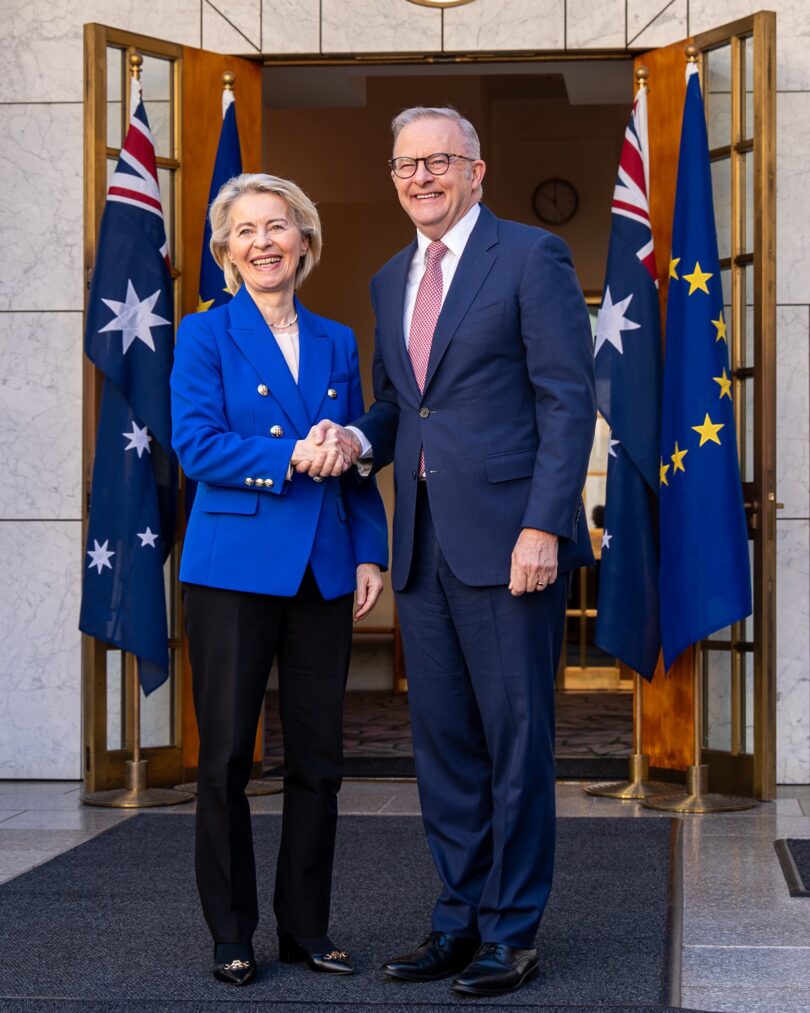
CANBERRA – In a historic breakthrough following eight years of arduous negotiations, Australian Prime Minister Anthony Albanese and European Commission President Ursula von der Leyen have formally concluded the Australia-European Union Free Trade Agreement (A-EU FTA).
The deal, announced on March 24, 2026, during von der Leyen’s state visit to Canberra, marks a strategic pivot for both economies as they seek to insulate themselves from global supply chain volatility and reduce reliance on single-market dependencies.
A Strategic Alliance Amid Global Turbulence
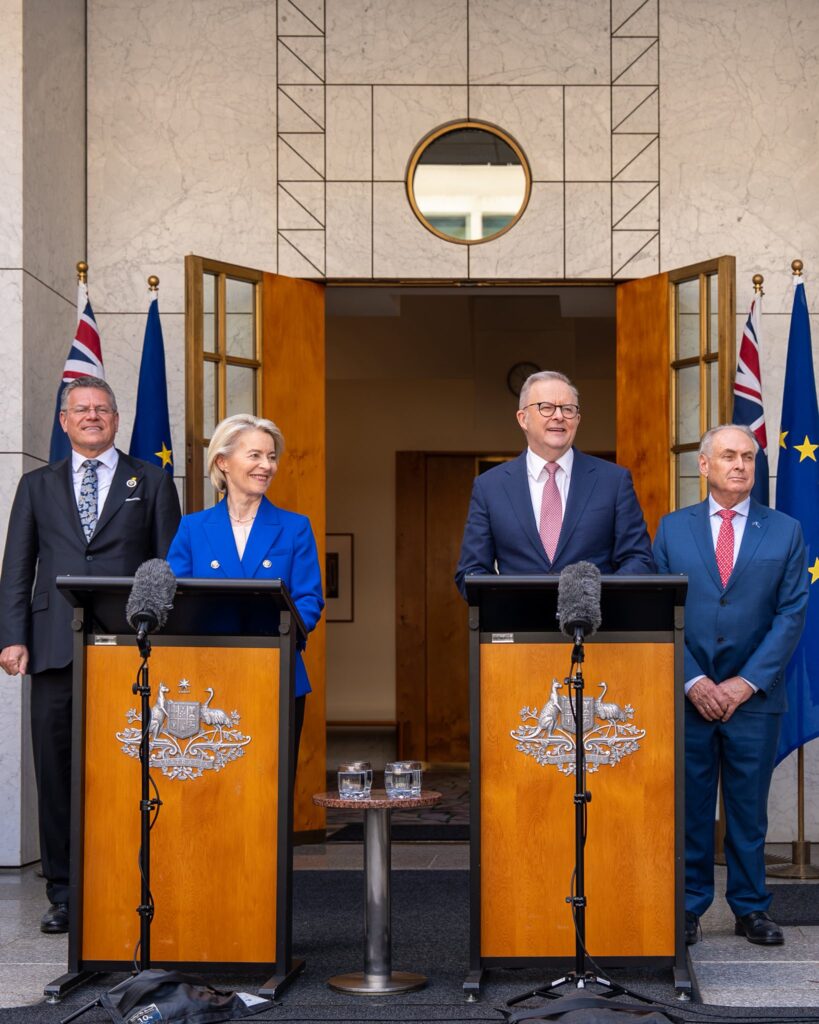
The agreement arrives at a critical geopolitical juncture. Speaking at a joint press conference, President von der Leyen characterized the pact as more than a mere commercial transaction. “In a world where trade is increasingly used as leverage, this agreement sends a clear signal: friendship and cooperation are the ultimate stabilizers,” she stated.
Prime Minister Albanese echoed this sentiment, describing the deal as a “defining moment” that secures Australia’s role as a “renewable energy superpower” for the European continent.
Key Pillars of the Agreement
| Sector | Impact |
| Critical Minerals | 99% of tariffs removed on lithium, manganese, and cobalt. |
| Industrial Goods | Elimination of 5% tariffs on EU cars, machinery, and chemicals. |
| Agriculture | 98% of Australian exports to enter the EU duty-free. |
| Investment | Preferential access to €845 billion in EU government contracts. |
The “Green” Engine: Critical Minerals and Hydrogen
A centerpiece of the deal is the elimination of tariffs on critical minerals and green hydrogen. For the EU, which is aggressively pursuing its Green Deal industrial plan, Australia offers a stable, democratic source of the raw materials needed for electric vehicle (EV) batteries and wind turbines.
-
Tariff Removal: Duties on lithium hydroxide and rare earths—previously as high as 5.5%—will be scrapped.
-
Investment Surge: The agreement raises the foreign investment screening threshold for EU private investors, expected to trigger a wave of European capital into Australian mining and downstream processing.
Agricultural Compromise and “Geographical” Peace
The path to the deal was nearly derailed by disputes over agricultural quotas and “Geographical Indications” (GIs). The final text represents a carefully calibrated compromise:
-
Naming Rights: Australia has agreed to protect 165 European food GIs and 231 spirit GIs. Names like Pecorino Romano and Ouzo will be phased out for Australian-made products.
-
The “Feta” Grandfathering: In a win for local producers, Australian dairy farmers who have used terms like Feta or Gruyère for more than five years can continue to do so, provided the origin is clearly labeled.
-
Beef and Sheep: While the EU opened two new tariff-rate quotas (30,600 tonnes for beef and 25,000 tonnes for sheep meat), the National Farmers’ Federation (NFF) expressed “extreme disappointment,” arguing the access remains too restrictive compared to deals the EU has signed with other regions.
Looking Ahead
The agreement now moves to domestic parliamentary processes in both Canberra and Brussels for formal ratification. Beyond trade, the leaders also signed a new Security and Defence Partnership, aimed at increasing cooperation on cyber security and maritime safety in the Indo-Pacific.
With the global economy navigating “choppy trade waters,” as Australian Trade Minister Don Farrell put it, this deal provides a much-needed anchor for two of the world’s most like-minded partners.
EU-Australia Trade Deal: Historic Breakthrough