

New ‘Crime Influencers’ Threat: AFP Commissioner Krissy Barrett Warns of Online Sadism Targeting Youth
News Agreggator by Gemini /Fact checking by A.Ritenis
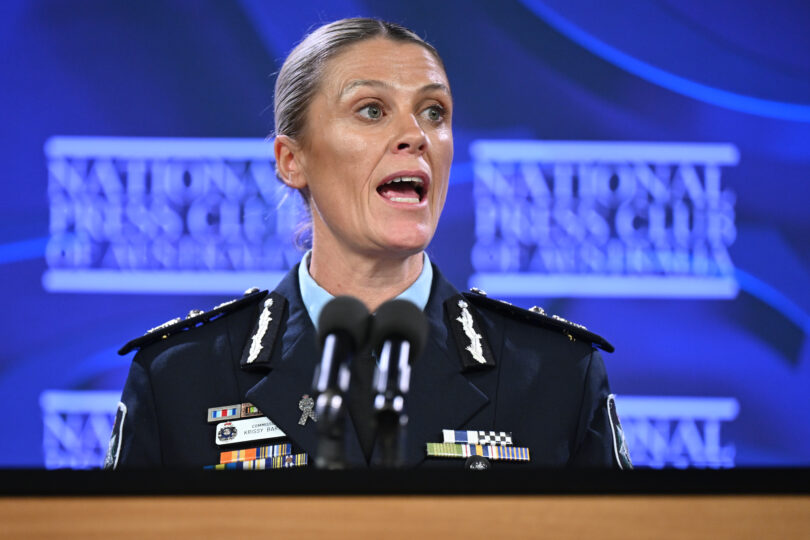
Image of AFP Commissioner Chrissy Barret by AAP
AFP Commissioner Krissy Barrett has delivered a stark warning about “decentralised online crime networks” and the emergence of “crimefluencers” who are glorifying sadistic online exploitation, cyber-attacks, and violence. In her National Press Club address, the Commissioner outlined a disturbing new front in gender-based violence, where crimes are spilling from the virtual world into real-world consequences. The AFP is responding with a new dedicated Taskforce Pompilid and an aggressive new strategic posture for the agency.
Key Takeaways from the Commissioner’s Address
A Disturbing New Online Threat: ‘Crimefluencers’
Commissioner Barrett highlighted a growing and deeply worrying trend: loosely affiliated individuals, overwhelmingly young boys and young men from Western English-speaking backgrounds, who form online networks motivated by anarchy, sadism, nihilism, Nazism, and Satanism.
- The Victims: The main targets are pre-teen or teenage girls, typically with vulnerabilities such as low self-esteem, mental health disorders, a history of self-harm, or eating disorders.
- The Motivation: The perpetrators’ motives are not financial or for sexual gratification, but purely for “amusement—for fun—or to be popular online”.
- ‘Twisted Gamification’: These networks operate with a culture similar to multi-player online gaming. Perpetrators hunt, stalk, and draw in victims, often being required to pass a test or provide gruesome content to gain acceptance. Victims are groomed and then forced to perform serious acts of violence on themselves, their siblings, others, or pets. In a chilling practice, perpetrators “trade their victims with each other—just like in an online game.”
- AFP Action: The AFP has already identified 59 alleged offenders in Australia associated with these networks, leading to three domestic arrests (aged 17-20) and nine international arrests based on AFP intelligence.
New AFP Posture: Defending Australia’s Sovereignty
The Commissioner announced a shift in the AFP’s mission statement to: “Defend and protect Australia and Australia’s future from domestic and global security threats.” This requires the AFP to supercharge its global operations, emphasizing its role as a national security agency.
- Taskforce Pompilid: This new, permanent taskforce will specifically identify, disrupt, and dismantle these online criminal ecosystems. It will focus on protecting victims, arresting offenders, and removing the anonymity that shields criminals.
- Supercharging Global Operations: The AFP will take more deliberate and active actions with overseas partners, aiming to stop criminality in the country it originates in to prevent it from reaching Australian shores. An example provided was the AFP-Colombian cooperation, which has resulted in the seizure of more than eight tonnes of cocaine in the past couple of years.
- National Security Threats: The Commissioner declared that an individual suspected of being responsible for tobacco-related arsons and an alleged politically-motivated arson attack on the Adass Israel Synagogue is a “Number One priority” national security threat.
Tackling Youth Radicalisation and Enhancing Capability
The Threat of Youth Radicalisation
The speech also highlighted the ongoing threat of youth radicalisation, largely driven through social media and online gaming:
- Case Load Statistics: Since 2020, 48 youths aged 12-17 have been investigated by Joint Counter Terrorism Teams, with 25 charged with terrorism-related offences.
- 54% were religiously motivated.
- 22% were ideologically motivated.
- 11% had a mixed or unclear ideology.
- The AFP is recording a growing trend toward ideologically motivated, mixed, or unclear motivation.
- Analysing the Threat: The AFP has tasked a senior operational psychologist to analyse the 48 youth cases to better understand their vulnerabilities, online use, and motivations, with the goal of developing prevention strategies.
Technological Edge and Community Cohesion
- AI for Crime-Fighting: The AFP is working with Microsoft to develop a prototype AI tool to interpret emojis and Gen Z and Alpha slang in encrypted chats to quickly identify sadistic online exploitation and save children from harm earlier.
- Crypto Crackers: The Commissioner praised the ingenuity of AFP data scientists, citing a case where one used innovative methodology to decode a number sequence, recovering a crypto wallet containing $9 million in criminal proceeds.
- Building Trust: The AFP is establishing a Social Cohesion Consultative Board by the first quarter of next year, bringing together community leaders, youth, mental health experts, and diaspora groups to find common ground and agreed solutions for complex offences like youth radicalisation and human trafficking. This effort is designed to prevent crime and protect people who do not traditionally trust police.
The AFP’s message to the community is clear: “You are not alone.” Parents and carers are urged to have open conversations with their children and utilise resources like the AFP-led Australian Centre to Counter Child Exploitation website ().
The video below offers another perspective on the Commissioner’s address to the National Press Club.
IN FULL: Krissy Barrett APM’s Address to the National Press Club of Australia